
22
Dec
Transportation Crisis in Bolivia: Between Technical Efficiency and the Right to Mobility
Transportation Crisis in Bolivia: Between Technical Efficiency and the Right to Mobility
The determination of public transportation fares in Bolivia has returned to the center of national debate following recent fuel price adjustments. However, to understand the magnitude of the problem, it is imperative to break down what truly constitutes vehicle operating costs. These costs are not limited solely to diesel or gasoline; they encompass a complex structure that includes tire wear, lubricants, spare parts, and corrective and preventive maintenance. Crucially, this cost must also include the daily income of the driver and owner, guaranteeing a decent living wage to support the families who depend on this sector.
A critical component in this equation is the Passenger-Kilometer Index (PKI). Given the rising cost of living and fuel, there is a risk of decreased demand; however, it is unlikely that this index will drop drastically. Urban mobility is not a luxury, but a basic necessity and a human right that enables access to other rights such as work, health, and education. Therefore, people will continue to travel, even if it means sacrificing other consumption, which maintains the social relevance of the system.
Despite inflationary pressures, technical studies suggest that the transportation fare in any Bolivian city should not increase by more than 40 cents. A larger increase would lack technical justification and disproportionately impact the popular economy (we suggest watching the following video, which explains in more detail how the technical public transportation fare is calculated: https://www.youtube.com/watch?v=9w-DGJChDLk). It is crucial to clarify that this increase is not a direct and exclusive consequence of the fuel price hike, but rather stems from a much deeper structural problem: the systemic inefficiency of Bolivian transportation.
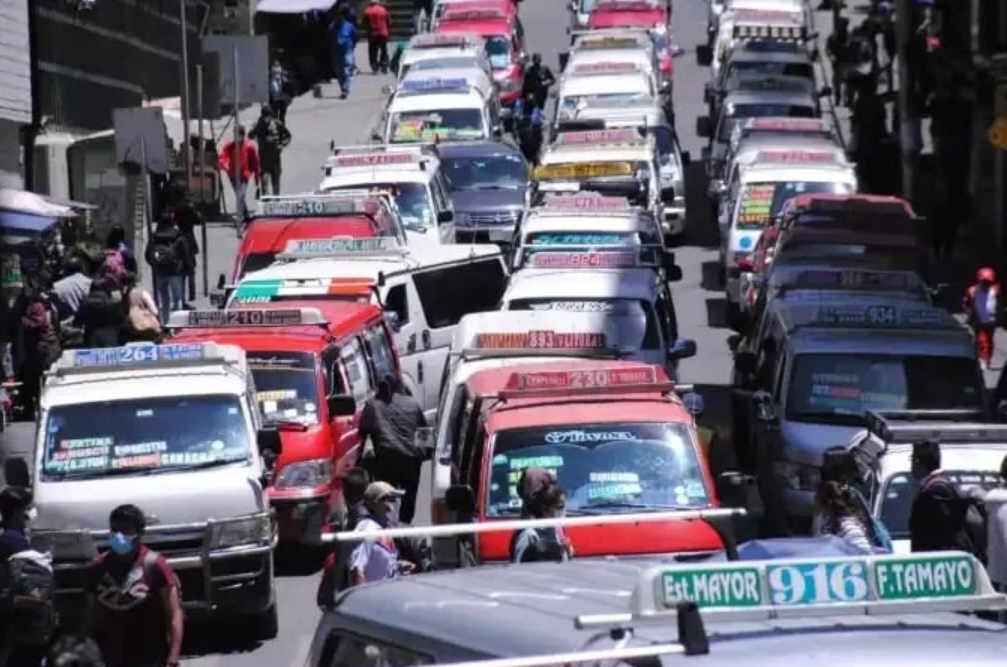
The current model is characterized by a "miniaturization" of the service. The proliferation of low-capacity vehicles (minibuses and vans) instead of high-capacity buses leads to a saturation of the vehicle fleet. This fragmentation causes the cost per passenger to be unnecessarily high, since more vehicles, more drivers, and more fuel are required to transport the same number of people that a single mass transit system could move more cheaply.
This inefficiency keeps the roads of Bolivia's main cities in a state of permanent congestion. Congestion not only degrades the quality of life for citizens but also directly affects the productivity of the transport operators themselves. In a collapsed system, drivers spend more time stuck in traffic than transporting passengers, which reduces their daily trips and, therefore, their profitability, trapping them in a vicious cycle of low productivity.
The current system holds both sides of the coin hostage. On the one hand, the user suffers from a precarious, slow, and increasingly expensive service. On the other hand, the operator is forced to work grueling shifts under extremely stressful conditions to cover operating costs inflated by the very chaos of the traffic. Both actors are victims of an outdated model that no longer responds to the urban dynamics of the 21st century.
The definitive solution lies not in annual fare adjustments, but in a profound and structural modernization. Bolivia requires a transition to mass transit systems that optimize road space and reduce the operating cost per passenger. Only through the implementation of Bus Rapid Transit (BRT), metropolitan trains, or high-capacity systems can we speak of a fair fare that is sustainable for both citizens and transportation providers.
This change must be multimodal and integrated, where different modes of transport (cable cars, buses, trains, and bicycles) operate under the same network logic. Integration must be not only physical but also fare-based, allowing a single payment to cover combined journeys. This would eliminate the "penny-for-penny" competition on the streets, which is the root of much of the current reckless driving and disorder.
For this transformation to be successful, high community participation is essential. Modernization processes cannot be imposed from above; they must be negotiated with transport unions to facilitate their transition to modern operating companies, and with residents to ensure that routes meet the real needs of neighborhoods. Transportation must be seen as a common good, not a battleground for sectoral interests.
In conclusion, the debate over the 40-cent fare is merely the tip of the iceberg of a systemic crisis. Bolivia urgently needs to move beyond "miniaturized" and congested public transportation systems and advance toward dignified urban mobility.
Compartir